
POLITICS — February 18, 2026
Islamic Emirate Leader Issues Law on Preachers' Methods and Guidelines
The leader of the Islamic Emirate of Afghanistan has issued a law regulating religious preachers, requiring them to follow Hanafi jurisprudence, exhibit good conduct, and avoid images of living beings in media. Religious scholars praised the measure for promoting unity and proper invitation methods.
The Ehtebar Desk — originates with ToloNews — corroborated by Afghanistan International — 2 min read
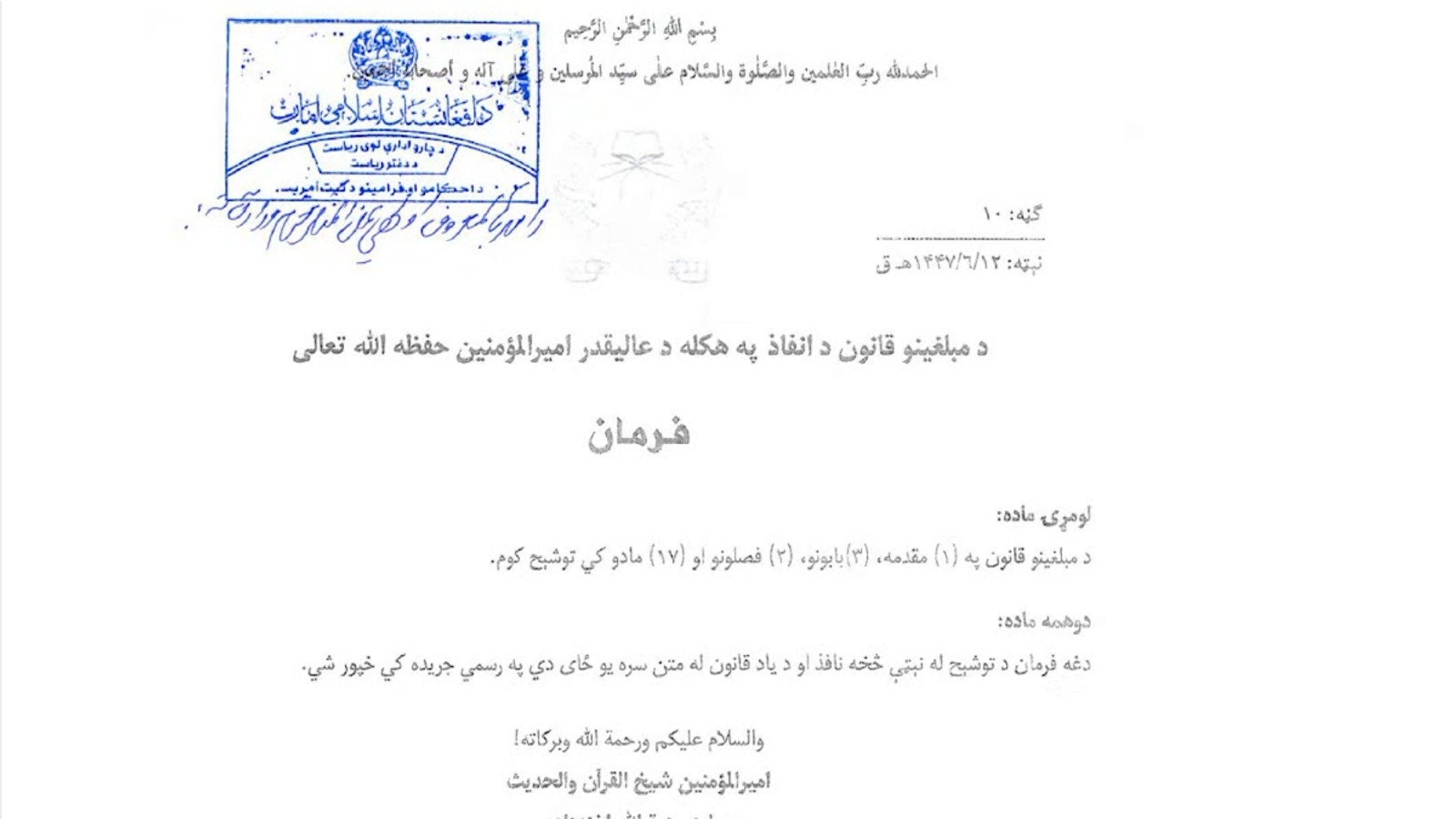
The leader of the Islamic Emirate of Afghanistan has issued a law regulating the methods of religious propagation, preachers' invitations, and related guidelines.
The law, consisting of two chapters and 17 articles—a copy of which was obtained by ToloNews—states that the activities of propagandists will be regulated by the Ministry of Promotion of Virtue and Prevention of Vice.
Under the law's section on preachers' characteristics, they must be followers of the Hanafi madhhab, adults, sane, and possess knowledge and mastery over the subjects they promote. Additional traits include being Muslim, sincere, kind, and patient. Obligations listed are maintaining good behavior with people and not being accompanied by women or children during propagation.
Religious scholar Hassani Sabzazadeh stated: "Since we live in Afghanistan in Asia where Hanafi jurisprudence predominates and the majority support it, making a law for all madhhabs could create problems in some issues; of course, differences are in branches, not principles. For unity, agreement, and a comprehensive law, we prioritize Hanafi jurisprudence."
Hasebullah Hanafi, another religious scholar, told ToloNews: "The Lord commands the Prophet (PBUH) to invite people in a good manner, not to behave harshly, and to act in a way that people do not become averse to the religion. We should not have preachers with bad conduct in society, and this law is a very good and positive step."
The law's section on propagation methods allows preachers to use speech, good morals and deeds, the path of jihad struggle, and social media such as radio, magazines, and books, provided they do not contain images of living beings.
Some religious scholars believe implementing this law could have positive impacts on inviting people to faith.
Read the original reporting at ToloNews →
Reliability assessment
Key facts about the Islamic Emirate leader issuing a law on preachers' methods (2 chapters, 17 articles, regulated by Ministry of Promotion of Virtue, requirements like Hanafi madhhab) corroborated by two independent outlets (ToloNews, Afghanistan International), with ToloNews obtaining a copy of the law for direct attribution.
Across the newsrooms
Filed by 2 outlets
ToloNews
Originating
Afghanistan International
Filed under
Politics — Islamic Emirate of Afghanistan, Ministry of Promotion of Virtue and Prevention of Vice, Hanafi madhhab, religious propagation
Reader supported
Keep Ehtebar running
Every published story uses paid tools to translate reporting, compare sources, extract claims, and produce a clearer read on Afghanistan. Reader support helps keep that work independent.
€5
helps cover daily verification runs
€15
supports a week of source comparison
€50
keeps independent analysis moving
More in Politics

Islamic Emirate Leader Orders 21 New Appointments Across Government Posts
— Reliable

Discussion Held on Presenting Achievements of Government Program in Media
— Reliable
Supreme Court of the Islamic Emirate of Afghanistan Outlines Judicial Reforms and Achievements
— Unverified
Ministry of Information and Culture of the Islamic Emirate of Afghanistan Announces Annual Activities and Achievements
— Reliable