
SOCIETY — February 14, 2026
Mirwais Balkhi: Afghan Diaspora Has Dual Responsibilities Toward Afghanistan and Host Country
Mirwais Balkhi told a meeting at George Washington University that the Afghan diaspora must fulfill dual responsibilities to both host countries and Afghanistan while addressing integration challenges, particularly for women. Participants highlighted the human capital of post-Taliban exodus migrants and Afghanistan's resulting expertise shortage.
The Ehtebar Desk — originates with Amu TV — 2 min read
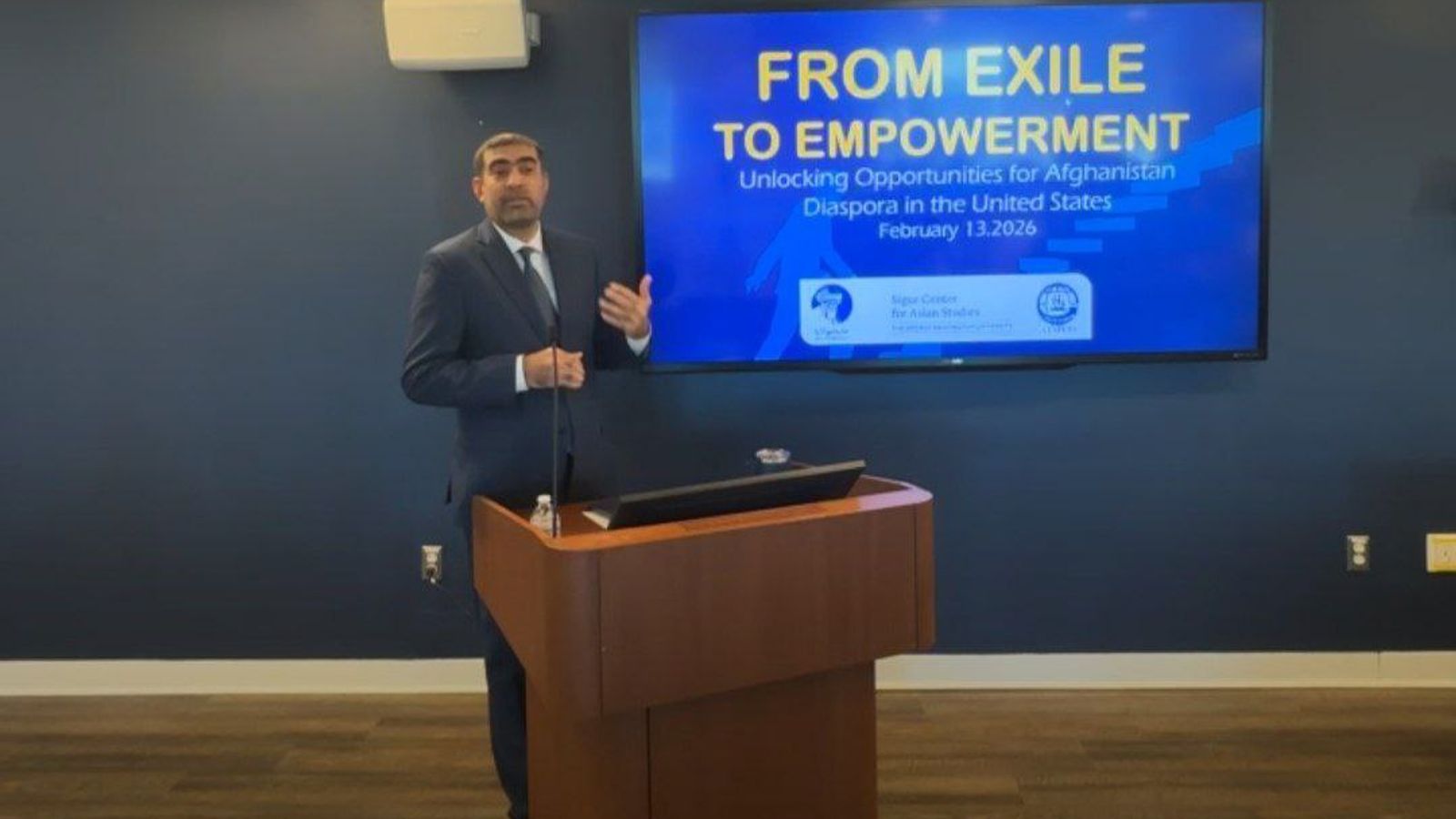
A meeting on the role and challenges of the Afghan diaspora, organized by the Mawlana House institution, was held at George Washington University in the United States.
Mirwais Balkhi, head of Mawlana House and one of the organizers, stated that the migrant community must acquire necessary capabilities in the host country to influence Afghanistan's internal discourse. He added, "As citizens of Afghanistan and as citizens of the new destination, we have a dual responsibility and must take on both responsibilities simultaneously."
Balkhi emphasized that diaspora means more than just being a migrant; it refers to someone who strives to be useful to the host country while also contributing to their homeland. He described the meeting's goal as moving "from diagnosis toward solutions," focusing not only on challenges but also on practical ways to empower the migrant community.
Participants stressed that Afghans who left after the Taliban returned to power possess significant human capital and can play roles in both societies. Omar Sharifi, a participant, said, "For many of us, leaving Afghanistan after the Taliban returned to power was an act of disobedience." He noted that many Afghans who entered the United States after 2021 were forcibly displaced rather than seeking a better life, viewing the move as a rejection of the Taliban and Talibanism.
One speaker addressed challenges faced by Afghan women integrating into the U.S. job market, including family responsibilities, childcare costs, lack of prior work experience, language barriers, and limited access to transportation.
Following the Taliban's return to power, numerous activists, academics, university professors, researchers, and experts left the country. Experts believe Afghanistan now faces a cadre vacuum, and filling it without their return will be difficult and time-consuming for future governments.
Read the original reporting at Amu TV →
Reliability assessment
Single source provides direct, on-record attribution to named individuals (Mirwais Balkhi, Omar Sharifi) at a specific location (George Washington University) with concrete details about the event; not a high-stakes or volatile claim.
Across the newsrooms
Filed by
Amu TV
Originating
Filed under
Society — Afghan diaspora, Mirwais Balkhi, Mawlana House, Taliban, brain drain
Reader supported
Keep Ehtebar running
Every published story uses paid tools to translate reporting, compare sources, extract claims, and produce a clearer read on Afghanistan. Reader support helps keep that work independent.
€5
helps cover daily verification runs
€15
supports a week of source comparison
€50
keeps independent analysis moving
More in Society
Health Officials and Experts Discuss Rise in Black Jaundice Cases in Afghanistan
— Reliable
Discussion on Agricultural Products and Health Services in Samangan Province
— Reliable
WHO Report Cites Taliban Restrictions and Funding Shortfalls as Threats to Health Services in Afghanistan
— Reliable
Afghan officials report returns of families from Pakistan and Iran alongside releases from Pakistani prisons
— Reliable