
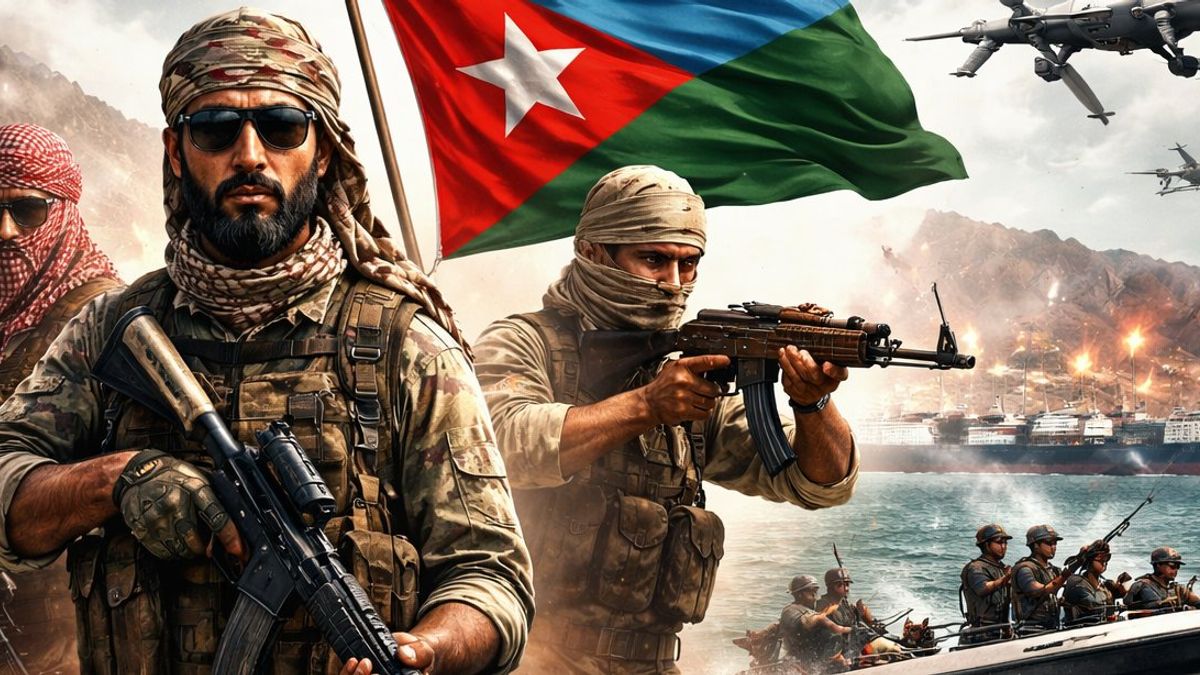
From Mountains to the Sea: The BLA’s Expanding Footprint and Strategic Vision
What is unfolding around the Baloch Liberation Army (BLA) is not a static insurgency adapting at the margins but rather a movement that has grown in strength, expanded its footprint, and is now attempting to project itself across multiple domains.
For years, the BLA operated as a small, fragmented insurgent force rooted in the mountains and remote districts of Balochistan. That phase has passed. Today, the group demonstrates not only sustained operational capacity, but also influence over pockets of territory where it exercises varying degrees of control and has begun to establish parallel governance structures. This evolution, from mobility to presence, from disruption to localized control, marks a significant shift in the nature of the conflict.
At the core of this transformation lies a more structured organization. Units like the Majeed Brigade have enabled high-impact, coordinated operations, while the development of intelligence mechanisms such as the Zephyr Intelligence Research & Analysis Bureau (ZIRAB) reflects improved planning, surveillance, and targeting. These are not the features of a declining insurgency, they point toward consolidation and maturity.
What is now emerging is the next phase.
In recent months, the BLA has announced the formation of new specialized units in quick succession. First came the Qazi Aero Hive Rangers (QAHR), positioned as a drone warfare wing. Then, following a maritime-type attack near Jiwani in the Arabian Sea, where a Pakistani Coast Guards patrol vessel was targeted and the guards killed, the group introduced the Hammal Maritime Defence Force (HMDF), signaling its entry into the maritime domain.
These developments should be understood in sequence, not isolation.
The BLA itself began as a limited insurgent formation, small in scale, constrained in capability, and operating at the margins. Over time, it built networks, expanded influence, and established a presence that now translates into control over certain areas and the emergence of parallel administrative structures.
The same logic appears to be guiding its expansion into new domains.
At present, neither QAHR nor HMDF can be understood as fully developed, sustained operational forces in the way conventional military structures function. But that is not the point. They represent the early stages of expansion where capability is still forming, but intent is clear, and the foundation is being laid.
Crucially, this expansion is inseparable from perception.
In modern conflict environments, perception is not a byproduct, it is a tool. By naming, announcing, and sequencing new units, the BLA is shaping how it is understood by multiple audiences: local populations, the state, and external stakeholders. It is signaling that its trajectory is not limited to land, but extends into air and sea.
Why this matters is straightforward.
Pakistan's coastline—from Karachi to Gwadar—has become one of the most strategically sensitive geographies in the region. It sits at the intersection of trade routes, energy corridors, and major infrastructure investments such as CPEC. In such an environment, even the perception of instability can have material consequences, affecting investor confidence, insurance costs, shipping decisions, and broader strategic calculations.
The Jiwani incident, followed immediately by the announcement of HMDF, must be read in this light. Whether the immediate operational capability is limited or not, the sequence introduces a new layer of perceived risk in the maritime domain. It signals that areas previously considered stable are now within the scope of the conflict.
This is where capability and perception begin to reinforce each other.
The BLA's trajectory shows that it has already evolved once from a small insurgent group into an actor with territorial influence and structured organization. That evolution was not instantaneous; it was built over time through incremental gains. Its expansion into aerial and maritime domains appears to follow the same pattern: early-stage capability, combined with deliberate narrative construction, aimed at long-term normalization of presence.
This is how insurgencies extend themselves.
They begin by signaling intent, shaping perception, and gradually building the capability to match it. Over time, what starts as projection can translate into operational reality. The conflict in Balochistan, therefore, is no longer confined to mountains and highways. It is extending outward into airspace, into coastal waters, and into the realm of perception where strategic outcomes are increasingly shaped.
The BLA today is operating on both fronts.
On the ground, it continues to consolidate influence. In the information domain, it is defining how that influence is interpreted. And in the current geopolitical environment, that combination is not incidental but rather smart and strategic.
The question is no longer whether the BLA is changing. It is how far this trajectory will carry it and how seriously its evolving mix of capability and perception will be taken by those who must respond to it.