
ECONOMY — April 18, 2026
Afghanistan's Industry and Commerce Minister Urges Turkey to Invest in Pharmaceutical Production
Nooruddin Azizi urged Turkey to invest in Afghanistan's pharmaceutical production sector during talks with his Turkish counterpart at the Fifth Antalya Diplomacy Forum. The meeting focused on trade and investment in multiple sectors as a UN study reported Afghanistan's trade deficit rising to 9.56 billion dollars in 2024 from 6.72 billion dollars in 2023 amid falling aid.
The Ehtebar Desk — originates with Amu TV — corroborated by Hurriyat — 2 min read
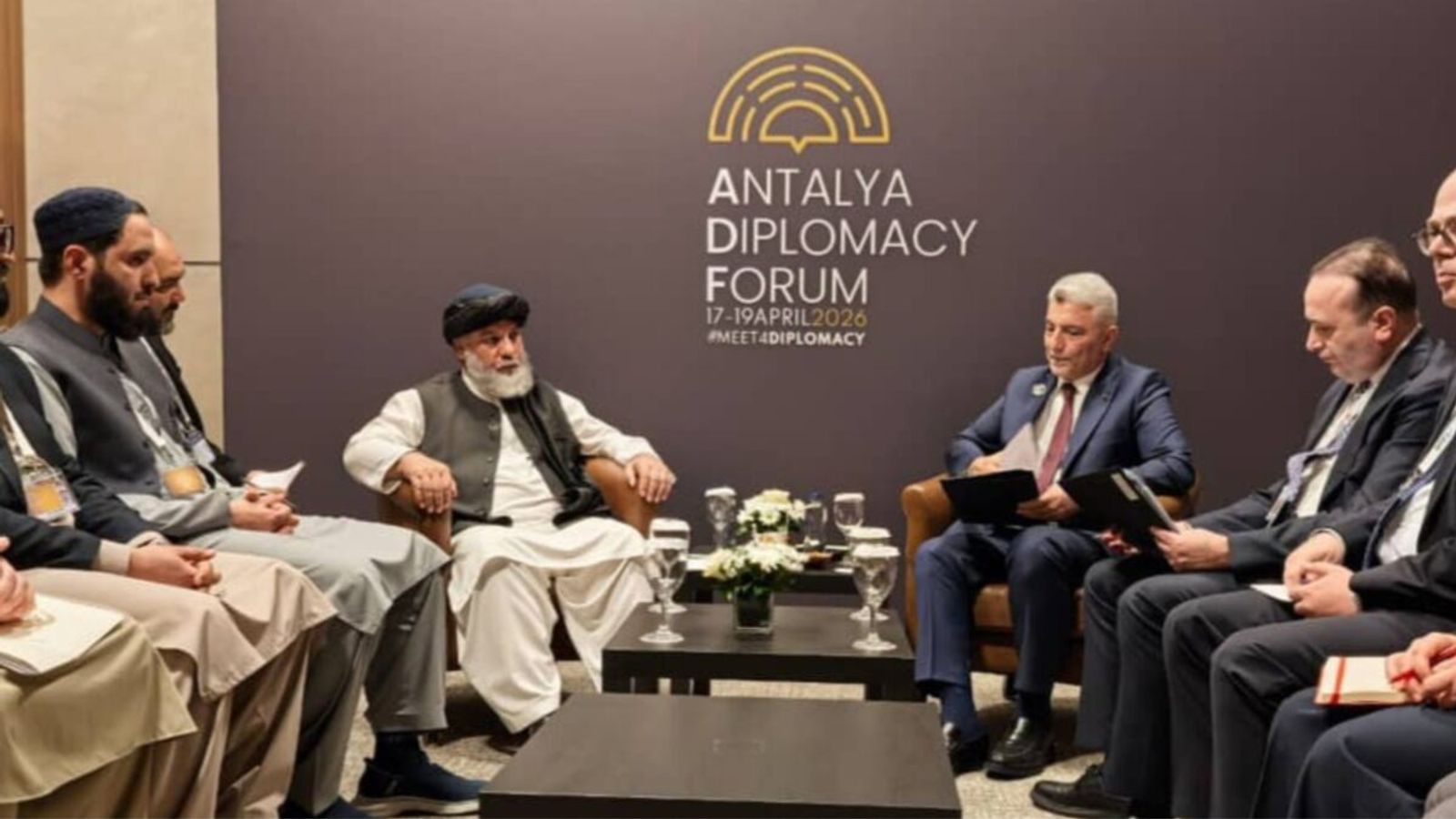
During a meeting on the sidelines of the Fifth Antalya Diplomacy Forum, Nooruddin Azizi, Afghanistan's Minister of Industry and Commerce, asked Turkey to make investments in the pharmaceutical production sector of Afghanistan. He was speaking with Omar Bolat, Turkey's Minister of Commerce.
In the course of their conversation, the two ministers covered topics related to increasing the level of trade between Afghanistan and Turkey. They looked at how to improve the capacities that Afghanistan has in order to bring in investments from foreign countries in areas such as industry, mining, agriculture and the production of pharmaceuticals.
The Turkish Minister of Commerce extended an invitation to the Afghan officials, asking them to take part in every exhibition that is organized in Turkey. Meanwhile, the ministers from both countries exchanged invitations that are meant to encourage additional investment activities.
In addition to the diplomatic engagement, a study carried out by the United Nations has provided new information on the economic situation in Afghanistan. The study indicates that there was a surge in the trade deficit of the country in 2024, when it reached 9.56 billion dollars. This is an increase from the 6.72 billion dollars that was registered in 2023.
The United Nations study also notes that the situation is taking place at a time when the amount of international aid is going down. This trend is causing concerns that there may be an increase in the number of people living in poverty and that there could be negative effects on social stability within Afghanistan.
Read the original reporting at Amu TV →
Reliability assessment
Both independent outlets corroborate the core event (the ministerial meeting, discussions, and mutual invitations) based on the Ministry of Industry and Commerce's official press release. This provides direct, attributable sourcing for the diplomatic engagement. Minor name spelling variations are transliteration differences, not conflicts. The UN economic data is single-sourced but does not contradict the primary story.
The source language reads straight.
Independent web corroboration
An independent web search turned up no separate corroborating reports. Treat the account as single-sourced until more outlets pick it up.
Across the newsrooms
Where reports agree
- Nooruddin Azizi met with Turkey's Minister of Commerce at the Fifth Antalya Diplomacy Forum in Turkey
- Discussions focused on boosting trade, investment in industry/mining/agriculture, and Afghanistan's economic capacities
- Turkey invited Afghan officials to participate in Turkish exhibitions
- Afghanistan's Minister requested Turkish investment specifically in the pharmaceutical production sector
Where reports differ
- Detailed UN report on Afghanistan's growing trade deficit and economic challenges is included only in Amu TV coverage
Filed by 2 outlets
Amu TV
Originating
Reported straight
Reported straight
Hurriyat
Reported straight
Reported straight
Filed under
Economy — Nooruddin Azizi, Turkey, Trade Relations, Pharmaceutical Investment, Antalya Diplomacy Forum
Reader supported
Keep Ehtebar running
Every published story uses paid tools to translate reporting, compare sources, extract claims, and produce a clearer read on Afghanistan. Reader support helps keep that work independent.
€5
helps cover daily verification runs
€15
supports a week of source comparison
€50
keeps independent analysis moving
More in Economy
Economic Commission Approves 37 Domestic Standards and 12 Testing Methods
— Reliable

Taliban Governor Says Around 700 Mines Under Extraction in Panjshir
— Reliable
Daily Production at Baghlan's Ghori Cement Factory Increases to 700 Tons
— Reliable
Two Irrigation and Flood-Prevention Projects Completed in Zabul
— Reliable