
ECONOMY — February 17, 2026
Taliban Economy Ministry: Over $1 Billion in Aid Allocated to Afghanistan in 2025
Taliban Economy Minister Din Mohammad Hanif reported that $1.009 billion in aid was allocated to Afghanistan in 2025, with $590 million spent on projects amid economic challenges and reduced humanitarian funding.
The Ehtebar Desk — originates with Amu TV — 2 min read
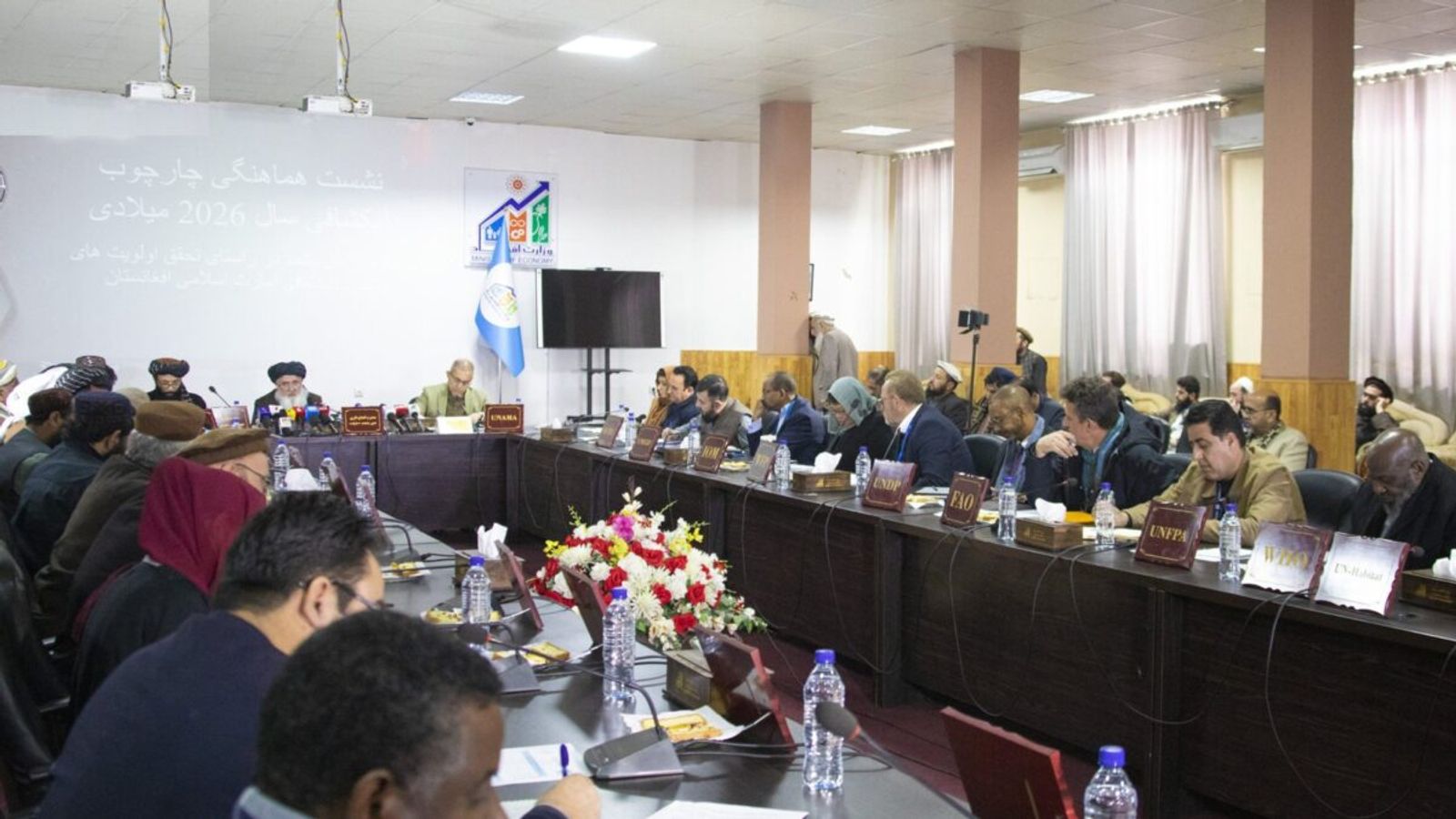
The Taliban Ministry of Economy announced a coordination meeting with United Nations agencies, stating that based on its statistics, $1.009 billion in aid was allocated to Afghanistan in 2025.
Of this amount, $590 million was spent on projects, with the remainder allocated for salaries, perks, offices, equipment, and assets, according to the ministry's statement.
The meeting on Tuesday was attended by Andrika Retoate, deputy special representative of the United Nations Assistance Mission in Afghanistan (UNAMA), heads of UN offices in Afghanistan, European Union representatives, and officials from several international organizations.
Taliban Economy Minister Din Mohammad Hanif expressed gratitude to the UN agencies, the EU, and all international partners for standing by the Afghan people during difficult years.
Hanif stated that Afghanistan faced a range of economic, social, and climatic challenges in 2025, including the impacts of climate change and natural disasters, the forced deportation of more than two million migrants from neighboring countries and their return, ongoing sanctions and frozen foreign reserves, and an unprecedented reduction in developmental and humanitarian aid, all of which directly affected the livelihoods of vulnerable segments of society.
Despite these challenges, he said efforts were made to maintain relative economic stability and increase growth compared to the previous year. These included strengthening economic management, supporting domestic production, focusing public and private investment on job-creating sectors, backing the private sector, facilitating business activation, stabilizing exchange rates, developing exports, implementing national infrastructure projects, controlling inflation, and increasing domestic revenues.
Hanif noted that the United Nations played an effective role in responding to the urgent needs of the Afghan people.
According to statistics from the UN Office for the Coordination of Humanitarian Affairs (OCHA), humanitarian aid in 2025 saw a significant decrease compared to the previous year. Of the $2.4 billion needed, only 36 percent, or $870 million, was obtained.
UN agencies have not yet commented on the meeting.
Read the original reporting at Amu TV →
Reliability assessment
Single source provides direct, on-record attribution from named Taliban Economy Minister Din Mohammad Hanif with concrete, checkable details including specific aid amounts ($1.009B allocated, $590M spent, OCHA figures), named participants (Andrika Retoate, UN heads), and meeting date; not a high-stakes or volatile ground event.
Across the newsrooms
Filed by
Amu TV
Originating
Filed under
Economy — Taliban, Economy Ministry, UNAMA, Humanitarian Aid, OCHA
Reader supported
Keep Ehtebar running
Every published story uses paid tools to translate reporting, compare sources, extract claims, and produce a clearer read on Afghanistan. Reader support helps keep that work independent.
€5
helps cover daily verification runs
€15
supports a week of source comparison
€50
keeps independent analysis moving
More in Economy
Economic Commission Approves 37 Domestic Standards and 12 Testing Methods
— Reliable

Taliban Governor Says Around 700 Mines Under Extraction in Panjshir
— Reliable
Daily Production at Baghlan's Ghori Cement Factory Increases to 700 Tons
— Reliable

Two Irrigation and Flood-Prevention Projects Completed in Zabul
— Reliable