
ECONOMY — April 28, 2026
Islamic Emirate Launches Three Electricity Projects Worth 1.12 Billion Afghanis in Faryab
Deputy Prime Minister Mullah Abdul Ghani Baradar inaugurated three electricity projects in Faryab province valued at 1.12 billion Afghanis. Funded by the Islamic Emirate and built by private contractors over three years, the initiative aims to upgrade transmission lines and substations to reduce regional power shortages.
The Ehtebar Desk — originates with Hasht-e Subh — corroborated by Pajhwok, Bakhtar News and RTA — 2 min read
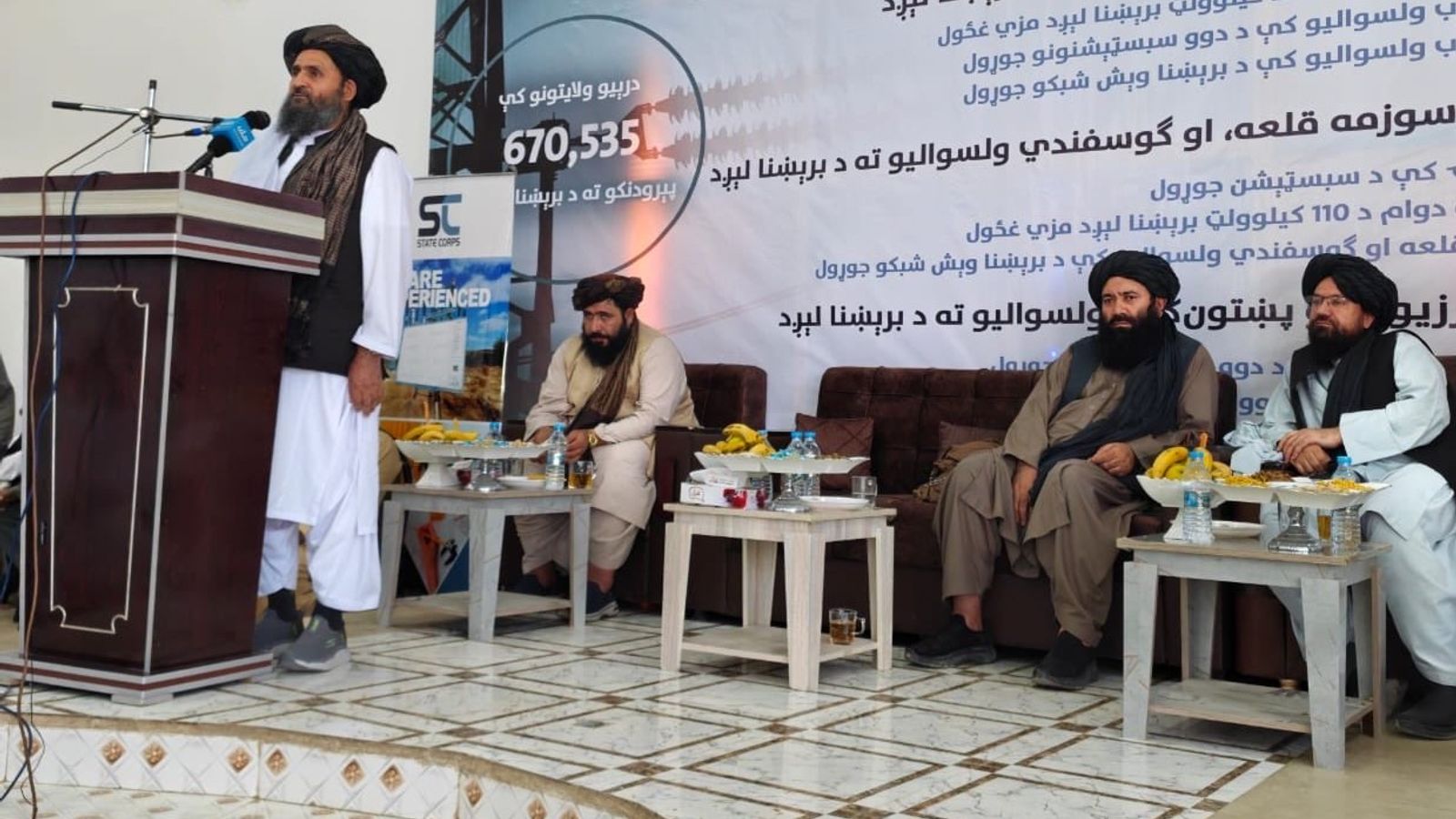
Deputy Prime Minister for Economic Affairs Mullah Abdul Ghani Baradar has inaugurated three electricity transmission and distribution projects in Faryab province, valued at 1.12 billion Afghanis. The initiative, funded by the Islamic Emirate of Afghanistan, is designed to address persistent power shortages in the region.
According to official statements, the projects will be executed by private sector contractors over a three-year period. The infrastructure development includes extending a 110-kilovolt transmission line to the Balchiragh and Garziwan districts, constructing a 110/20-kilovolt substation in Balchiragh, and expanding local distribution networks with 18 megavolt-ampere and 5 megavolt-ampere transformers.
Authorities stated that the completion of these projects will significantly improve the reliability of the regional power grid. By upgrading transmission lines and distribution capacity, officials expect to provide more stable electricity access to residential and commercial consumers across the affected districts.
The funding and implementation framework reflect a broader effort by the Islamic Emirate to expand national infrastructure through public-private partnerships. The Faryab projects represent one of several recent initiatives aimed at modernizing the country’s energy sector and reducing reliance on imported power.
Construction is expected to commence immediately following the inauguration, with progress monitored by relevant economic and energy ministries. Once operational, the upgraded network will integrate with existing provincial grids to support long-term economic activity and public service delivery in northern Afghanistan.
Read the original reporting at Hasht-e Subh →
Reliability assessment
Four independent outlets corroborate the core event with identical details. The reporting is directly attributed to official statements from the Deputy Prime Minister's Office for Economic Affairs and the Taliban spokesperson, providing concrete, verifiable specifics regarding location, budget, technical scope, and timeline.
The source language reads straight.
Across the newsrooms
Where reports agree
- All four sources confirm the inauguration of three electricity projects in Faryab province valued at 1.12 billion Afghanis.
- All sources attribute the launch to Deputy Prime Minister Mullah Abdul Ghani Baradar.
- All sources provide identical technical specifications, funding source (Islamic Emirate), implementation timeline (three years by private sector), and stated goal of reducing local power shortages.
Where reports differ
- No substantive disagreements exist across the sources. Minor transliteration variations in district names (Balchiragh/Belcheragh/Balchargh) do not constitute factual conflicts.
Filed by 4 outlets
Hasht-e Subh
Originating
Reported straight
Reported straight
Pajhwok
Reported straight
Reported straight
Bakhtar News
Reported straight
Reported straight
RTA
Reported straight
Reported straight
Filed under
Economy — Faryab, Electricity Infrastructure, Mullah Abdul Ghani Baradar, Islamic Emirate of Afghanistan, Energy Development
Reader supported
Keep Ehtebar running
Every published story uses paid tools to translate reporting, compare sources, extract claims, and produce a clearer read on Afghanistan. Reader support helps keep that work independent.
€5
helps cover daily verification runs
€15
supports a week of source comparison
€50
keeps independent analysis moving
More in Economy
Economic Commission Approves 37 Domestic Standards and 12 Testing Methods
— Reliable

Taliban Governor Says Around 700 Mines Under Extraction in Panjshir
— Reliable
Daily Production at Baghlan's Ghori Cement Factory Increases to 700 Tons
— Reliable
Two Irrigation and Flood-Prevention Projects Completed in Zabul
— Reliable