
ECONOMY — May 13, 2026
UNDP Report: 74 Percent of Afghans Unable to Meet Basic Needs
A UNDP report reveals that 74 percent of Afghans faced food or livelihood insecurity in 2025, citing economic weakness, climate shocks, and restrictions on women.
The Ehtebar Desk — originates with ToloNews — corroborated by Pajhwok, Hasht-e Subh, Khaama Press and 1 more — 2 min read
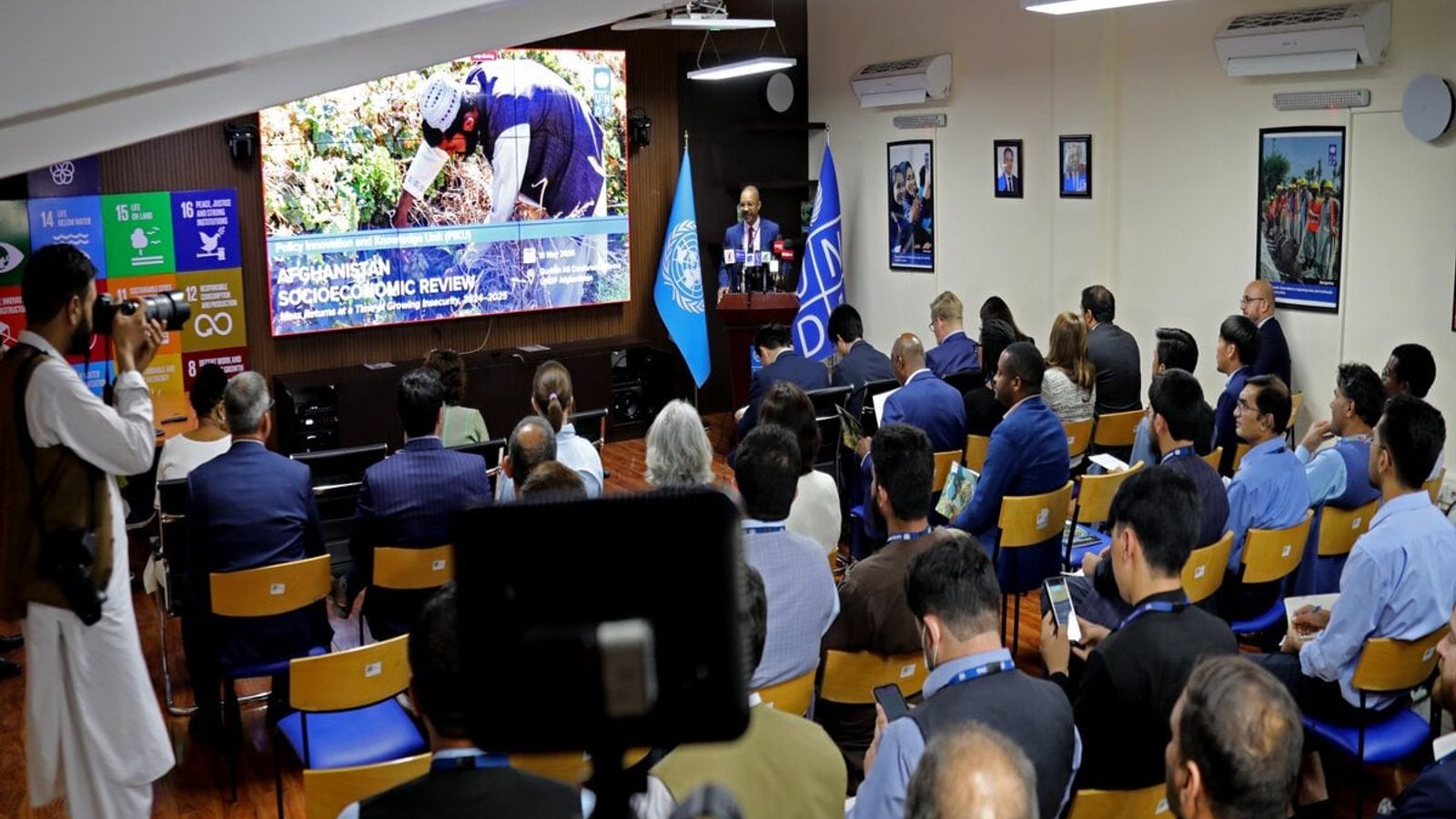
A new United Nations Development Programme (UNDP) report indicates that 74 percent of Afghans were unable to meet their basic life needs or faced food insecurity in 2025. The "Afghanistan Social and Economic Review 2024-2025" attributes this crisis to a weak economy, structural limitations, and severe climate shocks.
The report states that while Afghanistan's real GDP grew by 1.9 percent in the 2024-2025 fiscal year, real GDP per capita decreased by approximately 2.1 percent due to rapid population growth. Consequently, more than 80 percent of Afghan households were in debt in 2025.
Environmental and health challenges have further strained the population. Drought affected 64 percent of families, and access to drinking water dropped from 59 percent to 44 percent. Additionally, over 440 health centers closed or reduced their services in 2025 due to budget shortages.
The UNDP highlighted a significant gap in education, noting that girls' school attendance in 2025 was 42 percent, compared to 73 percent for boys. The report and diplomatic representatives emphasized that Taliban restrictions on women and girls' education and employment are hindering the country's economic recovery and weakening healthcare access.
The report also noted the impact of a massive influx of returnees from Iran and Pakistan. However, reports on the scale of this movement vary, with figures ranging from 2.7 million to 7.2 million returnees in 2025.
Read the original reporting at ToloNews →
Reliability assessment
The core event (the release of the UNDP report) is corroborated by five independent sources. Most specific data points (GDP growth, poverty percentages, education rates, health center closures) are consistent across multiple outlets. The report is attributed to a named organization (UNDP) and specific officials (Stephen Rodriguez, Kenichi Masamato, Renatus Hansen) are quoted. Discrepancies in returnee numbers are noted but do not invalidate the core event.
The source language reads straight.
Across the newsrooms
Where reports agree
- The UNDP released a report ('Afghanistan Social and Economic Review 2024-2025') detailing a severe humanitarian and economic crisis.
- 74% of the population struggled with basic needs/food insecurity in 2025.
- GDP growth was 1.9%, which was insufficient to keep pace with population growth.
- Over 80% of families are facing debt.
- Restrictions on women and girls' education and employment are hindering economic recovery.
- The return of migrants from Iran and Pakistan has placed additional strain on the economy.
Where reports differ
- The number of returnees in 2025 varies significantly: Amu TV reports 2.7 million, Pajhwok reports 2.9 million, and ToloNews (quoting Stephen Rodriguez) reports 7.2 million.
- Terminology for the 74% figure: Amu TV and Pajhwok refer to 'livelihood insecurity,' while Hasht-e Subh and Khaama Press refer to 'food insecurity.'
Filed by 5 outlets
ToloNews
Originating
Reported straight
Reported straight
Pajhwok
Reported straight
Reported straight
Hasht-e Subh
Reported straight
Reported straight
Khaama Press
Reported straight
Reported straight
Amu TV
Reported straight
Reported straight
Filed under
Economy — UNDP, Humanitarian Crisis, Poverty, Taliban, Migration
Reader supported
Keep Ehtebar running
Every published story uses paid tools to translate reporting, compare sources, extract claims, and produce a clearer read on Afghanistan. Reader support helps keep that work independent.
€5
helps cover daily verification runs
€15
supports a week of source comparison
€50
keeps independent analysis moving
More in Economy
Economic Commission Approves 37 Domestic Standards and 12 Testing Methods
— Reliable

Taliban Governor Says Around 700 Mines Under Extraction in Panjshir
— Reliable
Daily Production at Baghlan's Ghori Cement Factory Increases to 700 Tons
— Reliable

Two Irrigation and Flood-Prevention Projects Completed in Zabul
— Reliable