
ECONOMY — April 23, 2026
Coordination Meeting Held on Economic Policy Implementation Framework
Government officials convened to establish implementation and reporting frameworks for the Islamic Emirate of Afghanistan’s economic policy, emphasizing inter-ministerial coordination and standardized monitoring mechanisms.
The Ehtebar Desk — originates with RTA — 2 min read
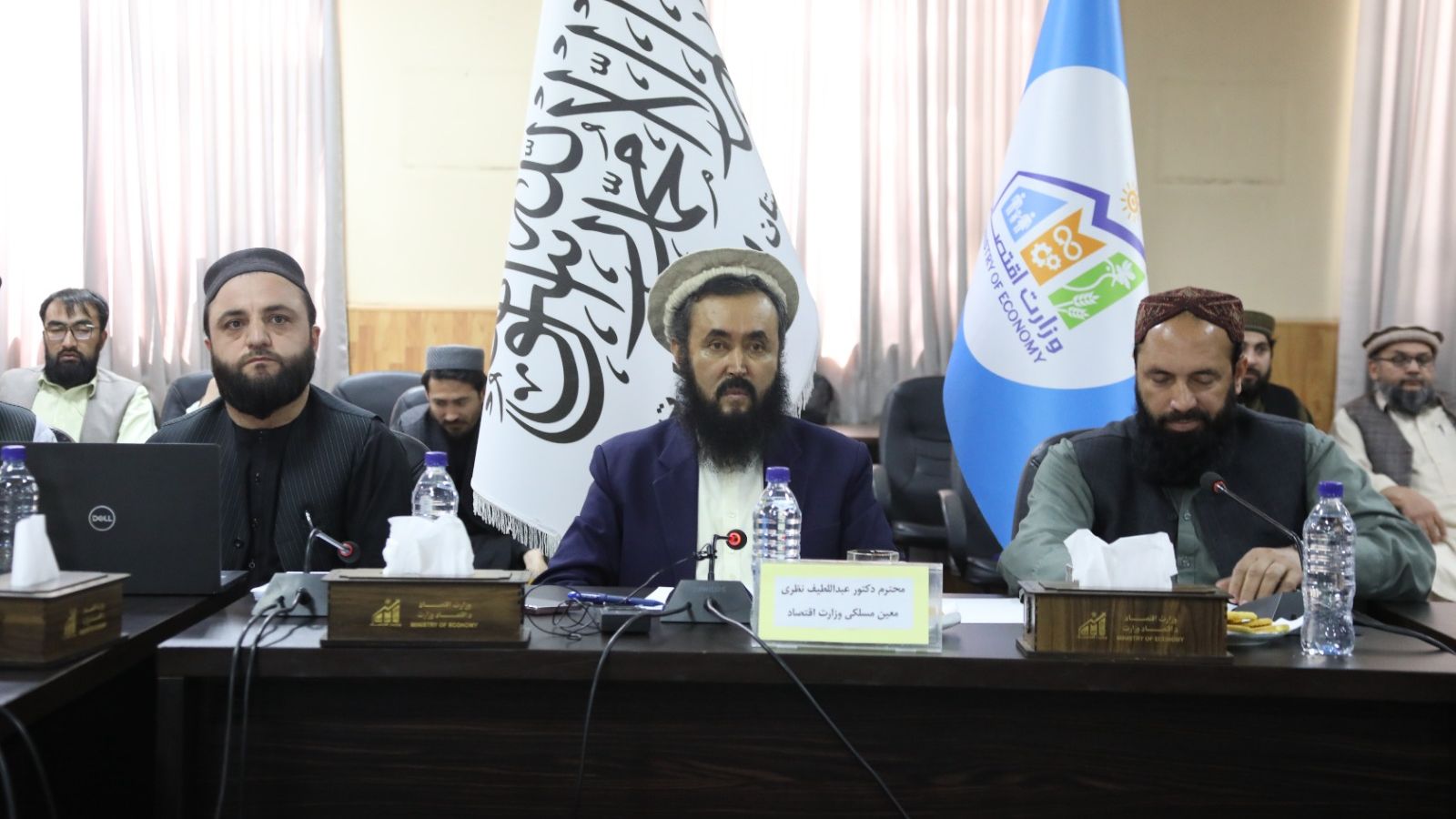
A high-level coordination meeting was convened to establish implementation mechanisms and reporting frameworks for the Islamic Emirate of Afghanistan’s economic policy. The session was led by the Deputy for Economic Affairs of the Prime Minister's Office and included representatives from multiple ministries and provincial administrations.
During the proceedings, Dr. Abdul Latif Nazari, Professional Deputy at the Ministry of Economy, addressed attendees on the strategic importance of the policy. He emphasized that the framework serves as a central instrument for achieving national macroeconomic objectives and stressed the necessity of sustained cooperation across government departments.
Officials from the Economic Policy and Strategy Department of the Ministry of Economy presented a comprehensive implementation plan alongside a standardized reporting structure. The presentation outlined technical guidelines designed to streamline inter-ministerial coordination and ensure consistent monitoring of economic initiatives at both central and provincial levels.
Participants reviewed the proposed mechanisms and provided technical feedback aimed at refining execution protocols and enhancing reporting standards. Attendees expressed support for the framework, noting that structured coordination would improve policy delivery and administrative efficiency.
The meeting concluded with directives to integrate the finalized guidelines into routine government operations, with an emphasis on maintaining transparent communication channels between ministries and regional administrations. Officials indicated that the established reporting framework will serve as the baseline for tracking progress on economic targets in the coming fiscal period.
Read the original reporting at RTA →
Reliability assessment
Single-source report from RTA with direct, on-record attribution to named officials (Dr. Abdul Latif Nazari, Ministry of Economy) and specific institutional departments. The core event (a high-level coordination meeting on economic policy implementation) is clearly documented with concrete procedural details, meeting the threshold for reliable status per the single-source attribution rule.
The source language reads straight.
Across the newsrooms
Filed by
RTA
Originating
Reported straight
Reported straight
Filed under
Economy — Ministry of Economy, Economic Policy, Abdul Latif Nazari, Prime Minister's Office, Provincial Administrations
Reader supported
Keep Ehtebar running
Every published story uses paid tools to translate reporting, compare sources, extract claims, and produce a clearer read on Afghanistan. Reader support helps keep that work independent.
€5
helps cover daily verification runs
€15
supports a week of source comparison
€50
keeps independent analysis moving
More in Economy
Economic Commission Approves 37 Domestic Standards and 12 Testing Methods
— Reliable

Taliban Governor Says Around 700 Mines Under Extraction in Panjshir
— Reliable

Daily Production at Baghlan's Ghori Cement Factory Increases to 700 Tons
— Reliable

Two Irrigation and Flood-Prevention Projects Completed in Zabul
— Reliable